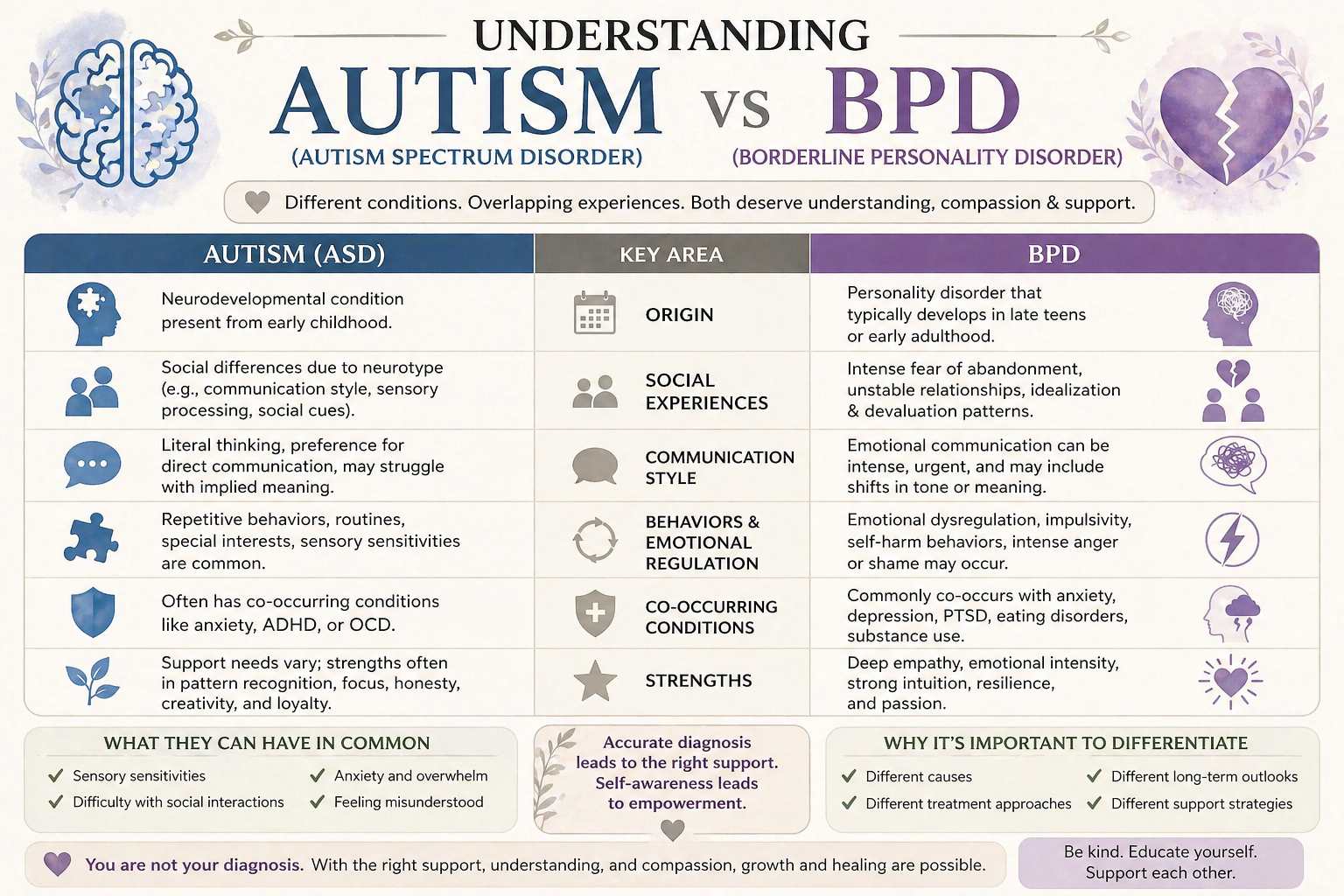
Key Differences & Why They’re Often Confused
“Autism and BPD can look similar on the surface — but their roots and experiences are very different.”
Understanding the difference between Autism Spectrum Disorder and Borderline Personality Disorder is essential for an accurate diagnosis and appropriate support.
Although both conditions can involve challenges with emotional regulation, social interaction, and daily functioning, they are fundamentally different in origin, development, and experience.
What Is Autism Spectrum Disorder?
Autism spectrum disorder (ASD) is a neurodevelopmental disorder, meaning it begins in early childhood and affects how the brain processes information.
Common traits include:
- Differences in social communication
- Difficulty reading social cues (like facial expressions or tone)
- Sensory sensitivities (light, sound, textures)
- Preference for routines
- Repetitive behaviors or movements
- Strong or specific interests
Autistic individuals often experience the world differently, especially when it comes to sensory input and communication.
What Is Borderline Personality Disorder (BPD)?
Borderline personality disorder (BPD) is a mental health condition that typically develops in early adulthood.
It is characterized by:
- Emotional dysregulation
- Intense fear of abandonment
- Unstable interpersonal relationships
- Rapid mood changes
- Impulsive behaviors
- Unstable self-image
People with BPD often experience emotions very intensely and may struggle with emotional stability in relationships and daily life.
Why Autism and BPD Are Often Confused
There is a significant overlap in some outward behaviors, which can lead to misdiagnosis.
Shared traits:
- Emotional intensity
- Difficulty in social relationships
- Challenges with emotion regulation
- Feeling misunderstood
- Struggles in social situations
For example:
- An autistic person may withdraw due to sensory overload
- A person with BPD may withdraw due to emotional distress
From the outside, these behaviors can look similar — but the underlying reasons are different.
The Core Difference: Brain vs Emotional Patterns
The most important distinction lies in the nature of each condition:
Autism
- Present from early development
- Linked to how the brain processes sensory information and communication
- Consistent patterns over time
BPD
- Develops later (often influenced by environmental factors)
- Centered around emotional instability and relationships
- Patterns may fluctuate depending on circumstances
The Importance of Accurate Diagnosis
Because of overlapping symptoms, differential diagnosis is crucial.
Misdiagnosis can lead to:
- Ineffective treatment
- Increased emotional distress
- Lack of appropriate support
That’s why evaluation by mental health professionals using proper diagnostic criteria (such as those from the DSM) is essential.
A Note on Autistic Women
Autistic women are more likely to be misdiagnosed with BPD due to:
- Masking behaviors (hiding autistic traits)
- Strong emotional responses
- Social difficulties
This makes awareness even more important.
Quick Takeaway
While autism and BPD may share some overlapping symptoms, they are distinct mental health conditions with different causes and support needs.
Understanding these differences is the first step toward better awareness, compassion, and care.
✅ In Part 2, we’ll break down the key differences in emotional regulation, sensory experiences, and social interaction between autism and BPD.
Emotional Regulation, Sensory Experiences & Social Interaction
The same behavior can come from completely different internal experiences.”
Although Autism Spectrum Disorder and Borderline Personality Disorder may appear similar outwardly, the internal experiences behind emotions, sensory input, and social interaction are very different.
Understanding these differences is key to recognizing each condition accurately.
Emotional Regulation: Different Roots
Both autism and BPD involve emotional regulation challenges, but they arise from different causes.
Autism: Overload-Based Emotions
In autism, emotional responses are often linked to:
- Sensory overload
- Sudden changes in routine
- Difficulty processing sensory information
This can lead to:
- Shutdowns (withdrawal)
- Meltdowns (overwhelm response)
👉 These reactions are not about relationships — they are responses to environmental stress.
BPD: Relationship-Driven Emotions
In BPD, emotional intensity is often tied to:
- Fear of abandonment
- Relationship instability
- Perceived rejection
This can result in:
- Rapid mood shifts
- Intense emotional reactions
- Strong need for reassurance
👉 Emotions are deeply connected to interpersonal relationships and attachment.
Sensory Experiences: A Key Difference
One of the clearest distinctions between the two conditions is sensory sensitivity.
Autism and Sensory Sensitivities
Autistic individuals often experience:
- Heightened sensitivity to sound, light, textures
- Strong reactions to sensory input
- Difficulty filtering environmental stimuli
This can lead to:
- Sensory overload
- Avoidance of certain environments
- Need for predictable routines
BPD and Sensory Processing
In BPD:
- Sensory issues are not a core feature
- Emotional experiences are more central than sensory ones
👉 While someone with BPD may feel overwhelmed, it is usually due to emotional stress — not sensory stimuli.
Social Interaction: Different Challenges
Both conditions affect social interaction, but in very different ways.
Autism: Communication Differences
Autistic individuals may:
- Struggle with social cues (tone, facial expressions)
- Prefer direct communication
- Find small talk confusing
- Have difficulty with theory of mind (understanding others’ perspectives)
👉 Social challenges are often due to differences in social communication, not lack of interest.
BPD: Relationship Instability
In BPD, social challenges often involve:
- Intense, unstable relationships
- Fear of abandonment
- Emotional dependency or withdrawal
- Rapid shifts between idealization and devaluation
👉 The difficulty is not understanding social cues — but managing emotional responses within relationships.
Behavioral Differences
Even when behaviors look similar, the motivation behind them differs.
Example: Withdrawal
- Autism → avoiding sensory overload
- BPD → avoiding emotional pain or rejection
Example: Emotional Outbursts
- Autism → response to overwhelm
- BPD → response to emotional triggers
Why This Distinction Matters
Misinterpreting these behaviors can lead to:
- Incorrect assumptions
- Misdiagnosis
- Inappropriate treatment
Understanding the “why” behind behaviors is essential for proper support.
Quick Comparison
| Area | Autism | BPD |
|---|---|---|
| Emotional triggers | Sensory & environmental | Relationship-based |
| Sensory sensitivity | Core feature | Not central |
| Social difficulty | Communication differences | Emotional instability |
| Behavior patterns | Consistent | Fluctuating |
Quick Takeaway
While autism and BPD may share surface-level similarities, their emotional, sensory, and social foundations are fundamentally different.
Recognizing these distinctions leads to better understanding and more effective support.
✅ In Part 3, we’ll explore diagnosis, overlapping symptoms, and why misdiagnosis happens — especially in autistic adults and women.
Diagnosis, Overlapping Symptoms & Misdiagnosis
“Getting the right diagnosis can change everything — but it’s not always simple.”
Distinguishing between Autism Spectrum Disorder and Borderline Personality Disorder can be challenging due to overlapping symptoms.
This complexity often leads to misdiagnosis — especially in adults and women.
Why Misdiagnosis Happens
There is a significant overlap in behaviors that can make autism and BPD appear similar at first glance.
Common overlapping traits:
- Emotional dysregulation
- Difficulty in social relationships
- Intense emotional responses
- Struggles in daily life
- Feeling misunderstood or different
Because of this, many individuals are initially diagnosed with one condition when they may actually have the other — or, in some cases, both.
The Role of Diagnostic Criteria
Mental health professionals rely on standardized guidelines such as the DSM (Diagnostic and Statistical Manual of Mental Disorders) to assess symptoms.
Autism diagnosis focuses on:
- Early development (symptoms present in childhood)
- Persistent differences in social communication
- Repetitive behaviors and routines
- Sensory sensitivities
BPD diagnosis focuses on:
- Patterns of unstable interpersonal relationships
- Emotional instability
- Impulsive behaviors
- Identity disturbances
- Fear of abandonment
👉 The key difference is that autism is a neurodevelopmental condition, while BPD is a personality disorder that develops later.
Autism in Adults: Why It’s Often Missed
Many autistic adults are not diagnosed in childhood, especially if they:
- Mask their autistic traits
- Develop coping strategies
- Appear socially functional on the surface
This can lead to:
- Late diagnosis
- Misinterpretation of behaviors
- Being labeled with other mental health conditions
The Case of Autistic Women
Autistic women are particularly at risk of misdiagnosis.
Why?
- Strong masking abilities
- Greater social adaptation
- Internalized emotional struggles
These traits can resemble BPD traits, such as:
- Emotional intensity
- Relationship difficulties
- Identity confusion
👉 As a result, many autistic women are diagnosed with BPD before autism is considered.
Masking: A Key Factor
Masking refers to hiding or suppressing autistic behaviors to fit social expectations.
This can include:
- Mimicking social behavior
- Forcing eye contact
- Suppressing sensory discomfort
While masking helps individuals navigate social situations, it can:
- Delay diagnosis
- Increase emotional exhaustion
- Lead to incorrect assessments
Can Someone Have Both Autism and BPD?
Yes — it is possible to have both conditions.
This is called comorbidity.
In such cases:
- Autism affects sensory and communication processing
- BPD affects emotional regulation and relationships
👉 A comprehensive evaluation is essential to identify both and provide appropriate support.
The Importance of Professional Assessment
Accurate diagnosis requires:
- Comprehensive assessments
- Detailed personal history
- Evaluation by trained mental health professionals
Sometimes, seeking a second opinion can be helpful if the diagnosis feels unclear.
Why Accurate Diagnosis Matters
Getting the right diagnosis leads to:
- More effective treatment
- Better understanding of oneself
- Access to appropriate support
- Improved long-term outcomes
Misdiagnosis, on the other hand, can delay progress and increase frustration.
Quick Takeaway
Because of symptom overlap, autism and BPD are often confused — especially in adults and women.
A thorough, informed diagnosis is essential to ensure the right support and treatment.
✅ In Part 4, we’ll explore treatment options, therapy approaches (like dialectical behavior therapy), and how support differs between autism and BPD — plus a reader survey.
Treatment Approaches, Support & Daily Life
“The right support doesn’t look the same for everyone — and that’s the point.”
Once an accurate diagnosis is made between Autism Spectrum Disorder and Borderline Personality Disorder, the next step is finding the right treatment approaches and support systems.
Because these are distinct mental health conditions, their care strategies are very different.
Treatment for Autism Spectrum Disorder
Autism is not something to “cure” — it’s a different way of experiencing the world. Support focuses on improving daily functioning and well-being.
Common support approaches:
- Occupational therapy → Helps manage sensory sensitivities and daily skills
- Social skills training → Supports communication and understanding of social cues
- Structured routines → Reduce overwhelm and improve stability
- Applied Behavior Analysis (ABA) (in some cases)
The goal is to create an environment that fits the individual’s specific needs.
Treatment for Borderline Personality Disorder
BPD treatment focuses on emotional regulation and relationship patterns.
Most effective therapy:
- Dialectical Behavior Therapy (DBT)
DBT helps individuals:
- Manage emotional dysregulation
- Develop coping strategies
- Improve interpersonal relationships
- Reduce impulsive behaviors
Other options include:
- Cognitive Behavioral Therapy (CBT)
- Medication (in some cases, for associated symptoms)
Key Difference in Treatment Approaches
Autism Support:
- Focus on environment and sensory needs
- Build skills and routines
- Long-term developmental support
BPD Treatment:
- Focus on emotional patterns
- Develop coping mechanisms
- Improve relationship stability
👉 Autism = adapting the environment
👉 BPD = regulating emotional responses
Daily Life Support Strategies
Regardless of diagnosis, support in daily life is essential.
For Autism:
- Create predictable routines
- Reduce sensory overload (quiet spaces, headphones)
- Allow time for recovery after social interaction
- Respect special interests
For BPD:
- Practice emotional regulation techniques
- Use grounding and mindfulness strategies
- Build stable support systems
- Identify emotional triggers
The Role of Support Systems
Both conditions benefit from strong support networks:
- Family understanding
- Friends who respect boundaries
- Access to mental health professionals
- Community or peer support
Feeling understood can significantly reduce emotional distress.
Long-Term Outlook
With the right support:
- Autistic individuals can thrive by embracing their strengths
- People with BPD can achieve emotional stability and healthier relationships
Early intervention and consistent care lead to better outcomes.
Final Takeaway
Although autism and BPD may share some overlapping symptoms, their treatment and support needs are very different.
Understanding these differences allows for:
- More effective care
- Better self-awareness
- Greater compassion