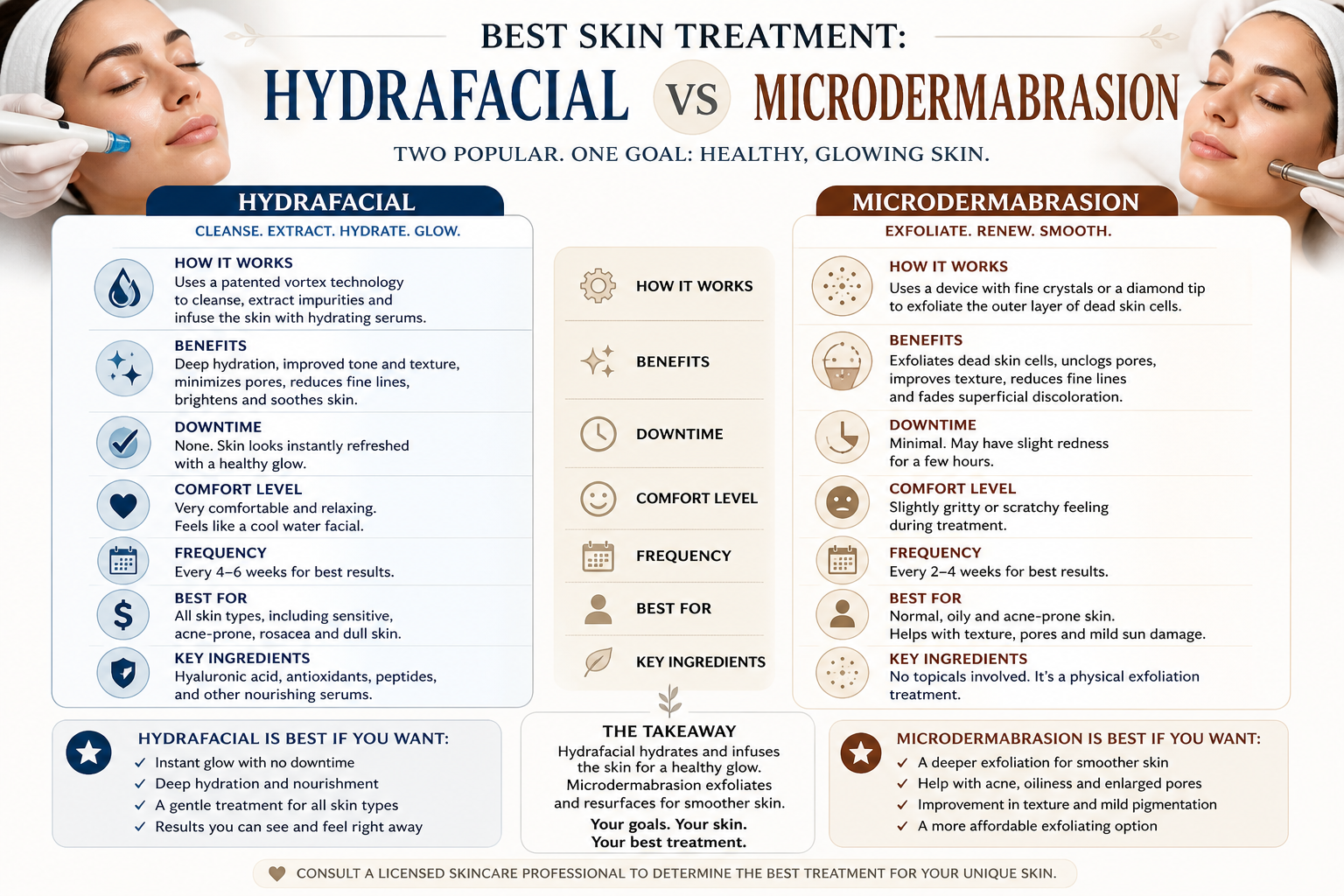
What’s the Difference & Which One Is Right for You?
“Both treatments promise glowing skin — but they work in completely different ways.”
If you’re looking for smoother, brighter, and healthier skin, you’ve probably come across two of the most popular treatments: Hydrafacial and microdermabrasion.
While both are effective, non-invasive options, they target your skin in very different ways — and choosing the right one depends on your skin type and specific skin concerns.
What Is a Hydrafacial?
A hydrafacial treatment is a modern, multi-step facial that combines:
- Cleansing
- Gentle exfoliation
- Extraction
- Deep hydration
It uses a specialized device with vortex technology to cleanse pores while infusing the skin with powerful active ingredients like hyaluronic acid.
Key benefits:
- Deep hydration
- Instant glow
- Minimal irritation
- Suitable for most skin types (even sensitive skin)
👉 It’s often chosen before a special event because of its immediate results.
What Is Microdermabrasion?
A microdermabrasion treatment focuses on physical exfoliation.
It uses:
- Fine crystals or
- A diamond tip attached to a handheld device
This process removes the outermost layer of dead skin cells, helping to improve:
- Skin texture
- Uneven tone
- Appearance of fine lines
Key benefits:
- Smoother skin
- Improved skin’s surface
- Better absorption of skincare products
👉 It’s a more traditional approach to exfoliation.
Core Difference: Hydration vs Exfoliation
The biggest difference between the two treatments is their main focus:
Hydrafacial
- Focus: Hydration + gentle exfoliation
- Approach: Multi-step, nourishing
- Result: Radiant skin with an instant glow
Microdermabrasion
- Focus: Deep exfoliation
- Approach: Mechanical resurfacing
- Result: Smoother skin and improved texture over time
Which Treatment Is More Effective?
Both treatments are considered effective treatments, but they serve different purposes.
Choose Hydrafacial if you want:
- Immediate glow
- Deep hydration
- A gentle approach
- Treatment for sensitive skin
Choose Microdermabrasion if you want:
- Stronger exfoliation
- Improvement in uneven texture
- Reduction of dark spots or mild acne scars
What About Results?
Hydrafacial:
- Immediate results
- Skin looks plump and radiant after a single session
- No downtime
Microdermabrasion:
- Gradual improvement
- Best results with regular treatments
- May cause slight redness temporarily
Are They Safe?
Both are non-invasive skin treatments and generally safe when performed by a skincare professional.
However:
- Hydrafacial is gentler and better for acne-prone or sensitive skin
- Microdermabrasion may not suit very sensitive or inflamed skin
Quick Takeaway
Hydrafacial and microdermabrasion are two of the most popular skincare treatments — but they serve different goals:
- Hydrafacial → hydration + glow
- Microdermabrasion → exfoliation + texture improvement
Choosing the right one depends on your skin’s needs and desired results.
✅ In Part 2, we’ll dive deeper into the benefits of each treatment, including how they affect collagen production, acne scars, and fine lines. ✨
Benefits for Skin, Fine Lines, Acne & Glow
“The best treatment isn’t the trendiest — it’s the one that solves your skin concerns.”
Now that you understand the basic differences between Hydrafacial and microdermabrasion, let’s break down what they actually do for your skin.
Each treatment targets specific concerns like fine lines, acne scars, and uneven skin tone — but in different ways.
Hydrafacial Benefits: Hydration & Instant Glow
The hydrafacial treatment is known for delivering immediate results with a gentle, multi-step process.
Key benefits:
1. Deep Hydration 💧
Hydrafacial infuses the skin with powerful ingredients like hyaluronic acid, helping to:
- Restore moisture
- Improve skin elasticity
- Create a plump, smooth appearance
2. Instant Glow ✨
One of the biggest advantages is the instant glow.
After a single session, skin looks:
- Brighter
- More radiant
- Healthier
👉 That’s why it’s popular before a special event.
3. Gentle Exfoliation
Hydrafacial removes dead skin cells without harsh abrasion.
This makes it ideal for:
- Sensitive skin
- Redness-prone skin
- Acne-prone skin
4. Improved Skin Health
Regular treatments support:
- Better skin health
- More even tone
- Reduced dullness
Microdermabrasion Benefits: Texture & Resurfacing
The microdermabrasion treatment focuses on improving the skin’s surface through physical exfoliation.
Key benefits:
1. Smoother Skin Texture
By removing the outermost layer of dead skin cells, microdermabrasion helps:
- Smooth rough patches
- Refine pores
- Improve overall texture
2. Reduction of Fine Lines
Exfoliation stimulates collagen production, which can reduce:
- The appearance of fine lines
- Early signs of aging
3. Fading Dark Spots & Sun Damage
Microdermabrasion can help improve:
- Dark spots
- Sun damage
- Uneven skin tone
4. Acne & Acne Scars
It can also reduce:
- Mild acne scars
- Surface-level imperfections
👉 Best results come with regular treatments.
Hydrafacial vs Microdermabrasion: Results Comparison
Hydrafacial Results:
- Immediate glow
- Deep hydration
- No downtime
- Gentle on skin
Microdermabrasion Results:
- Gradual improvement
- Smoother texture
- Brighter complexion over time
- Slight redness possible
Which One Is Better for Your Skin Concerns?
Choose Hydrafacial if you want:
- Hydration
- Radiant skin
- Gentle care
- Quick results
Choose Microdermabrasion if you want:
- Texture improvement
- Reduction of fine lines
- Treatment for uneven skin tone
- Long-term resurfacing results
Can You Combine Both?
Yes — in many cases, combining treatments can enhance results.
For example:
- Start with microdermabrasion to exfoliate
- Follow with hydrafacial for hydration
👉 This combination can improve both skin texture and overall glow.
Quick Takeaway
- Hydrafacial = hydration + instant glow
- Microdermabrasion = exfoliation + long-term texture improvement
Both are effective treatments, but they serve different purposes depending on your skin’s needs.
✅ In Part 3, we’ll compare downtime, safety, skin types, and who should avoid each treatment to help you make the best choice.
Downtime, Safety & Which Skin Type Should Choose What
“The best treatment is the one your skin can tolerate — not just the one that promises results.”
When choosing between a hydrafacial treatment and a microdermabrasion treatment, it’s essential to consider not just results — but also downtime, safety, and your skin type.
A treatment that works perfectly for one person may not be the right choice for another.
Downtime: What to Expect
One of the biggest differences between these treatments is recovery time.
Hydrafacial: No Downtime ✨
Hydrafacial is known for its gentle approach.
After treatment:
- Skin looks instantly hydrated
- No redness (or very minimal)
- You can return to daily activities immediately
👉 Perfect for last-minute glow before a big event.
Microdermabrasion: Minimal Downtime
Microdermabrasion is still non-invasive, but more intensive.
After treatment:
- Slight redness may occur
- Skin can feel sensitive for a few hours
- Mild dryness or tightness possible
👉 Recovery is short, but not completely invisible.
Safety: Which One Is Gentler?
Both are considered safe when performed by a skincare professional, but they differ in intensity.
Hydrafacial Safety
- Suitable for most skin types
- Ideal for sensitive skin
- Low risk of irritation
- Non-aggressive exfoliation
👉 Often recommended for beginners or reactive skin.
Microdermabrasion Safety
- Safe for normal to oily skin
- More aggressive exfoliation
- Not ideal for very sensitive or inflamed skin
👉 Requires more caution depending on your skin condition.
Best Treatment by Skin Type
Your skin type plays a major role in choosing the best option.
Sensitive Skin
👉 Best choice: Hydrafacial
- Gentle exfoliation
- Deep hydration
- Low irritation risk
Avoid strong mechanical exfoliation.
Dry Skin
👉 Best choice: Hydrafacial
- Focus on deep hydration
- Improves moisture balance
- Enhances skin barrier
Oily or Acne-Prone Skin
👉 Best choice: Both (depending on needs)
- Hydrafacial → for gentle cleansing and hydration
- Microdermabrasion → for deeper exfoliation and clogged pores
Aging Skin
👉 Best choice: Combination
- Microdermabrasion → boosts collagen production
- Hydrafacial → smooths and hydrates
Uneven Texture & Rough Skin
👉 Best choice: Microdermabrasion
- Strong exfoliation
- Improves skin texture
- Targets rough areas
Who Should Avoid These Treatments?
Avoid Hydrafacial if:
- You have active skin infections
- Severe rosacea flare-ups
Avoid Microdermabrasion if:
- Your skin is extremely sensitive
- You have active acne inflammation
- You experience frequent irritation
Professional Consultation Matters
Before choosing any treatment, it’s best to consult a skincare professional.
They can:
- Analyze your specific skin concerns
- Recommend the safest option
- Customize your treatment plan
👉 This ensures better results and avoids unnecessary irritation.
Hydrafacial vs Microdermabrasion: Safety Summary
| Factor | Hydrafacial | Microdermabrasion |
|---|---|---|
| Downtime | None | Minimal |
| Skin sensitivity | Very safe | Moderate caution |
| Intensity | Gentle | Stronger exfoliation |
| Best for | Hydration & glow | Texture & resurfacing |
Quick Takeaway
- Hydrafacial = safest, gentlest, no downtime
- Microdermabrasion = stronger exfoliation, slight recovery
Choosing depends on your skin’s tolerance and goals.
✅ In Part 4, we’ll cover which treatment is best for your goals, cost comparison, frequency, and include a reader survey to boost engagement. ✨
Which One Should You Choose? Cost, Frequency & Final Verdict
“The best skincare treatment is the one that fits your goals, your skin, and your lifestyle.”
After comparing benefits, safety, and results, the final step is choosing between hydrafacial and microdermabrasion based on your personal goals.
Let’s break it down simply.
Which Treatment Is Best for You?
Your decision should depend on what you want to achieve.
Choose Hydrafacial If You Want ✨
- Immediate glow
- Deep hydration
- A gentle, relaxing experience
- A treatment before a special event
- Minimal to zero downtime
👉 Best for:
Sensitive skin, dry skin, dull complexion
Choose Microdermabrasion If You Want 💎
- Smoother skin texture
- Reduction of fine lines
- Improvement in dark spots
- Long-term skin resurfacing
👉 Best for:
Oily skin, uneven texture, mild acne scars
Cost Comparison 💰
Prices vary depending on location and clinic, but here’s a general guide:
Hydrafacial:
- Higher cost per session
- Advanced technology involved
- Often includes multiple steps and serums
👉 Considered a premium skincare treatment
Microdermabrasion:
- More affordable
- Simpler procedure
- Widely available
👉 Great for regular maintenance
How Often Should You Do Each Treatment?
Consistency is key for best results.
Hydrafacial Frequency:
- Every 4–6 weeks
- Ideal for maintaining healthy skin
- Great before important events
Microdermabrasion Frequency:
- Every 2–4 weeks
- Works best as part of a long-term routine
- Gradual improvement over time
Can You Combine Them?
Yes — combining both treatments can give better results.
Example routine:
- Microdermabrasion → improves skin’s surface
- Hydrafacial → restores hydration and glow
👉 This approach targets both exfoliation and nourishment.
Final Verdict: Hydrafacial vs Microdermabrasion
Hydrafacial Wins For:
- Instant results
- Hydration
- Gentle care
- No downtime
Microdermabrasion Wins For:
- Deep exfoliation
- Texture improvement
- Long-term skin renewal
Expert Tip
If you’re unsure, start with a hydrafacial.
It’s the safest option for most skin types and gives visible results without irritation.
Then, introduce microdermabrasion if you want to target deeper concerns.
Quick Takeaway
- Hydrafacial = glow + hydration + instant results
- Microdermabrasion = exfoliation + texture + long-term improvement
👉 The best choice depends on your skin’s needs and your desired outcome.